Creating a living, intelligent FAQ thanks to AI: when every exchange becomes a resource
A dynamic FAQ, created by AI, reinforces autonomy and enhances exchanges between technicians and customers into a useful and lively knowledge base.

An FAQ that never answered anyone’s question
On a machine tool manufacturer’s website, a customer technician is looking for a simple answer: “How do I bleed the model X150 hydraulic unit?” He clicks on the FAQ. Nothing. He tries a keyword search: “purge”, “drain”, “oil”. Still nothing. He calls the technical hotline. Another technician asks the same question on WhatsApp. The latter, in a hurry, sends a voice message: “You close valve C, loosen the bleeder, and see if it flows clear.” Problem: this answer won’t be archived, updated or visible to others. Meanwhile, the official FAQ remains empty. Why is this? Because most FAQs are static, rarely updated, and far removed from the field. Today, however, every exchange can become an opportunity to produce useful knowledge, if we equip ourselves intelligently.
To remember
-
The majority of questions are already dealt with by the teams… but never capitalized on.
-
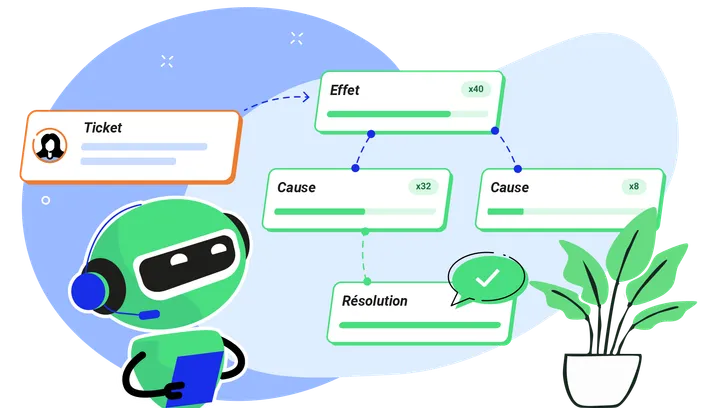
AI can capture, structure and sort responses given in context (WhatsApp, visio, phone; email).
-
A dynamic, contextualized and segmented FAQ (customers/technicians) becomes a lever for reducing solicitations and reinforcing autonomy.
1. Why traditional FAQs don’t work
They are written from the office, not from the field.
Often written by marketing or documentation departments, they lack precision, business language and real-life cases.
They are not updated as incidents occur.
Once published, they quickly become obsolete, especially in a constantly evolving technical environment (new models, bugs, replaced components).
They do not cover real cases
In reality, however, the questions are formulated in a natural way:
-
“Why does the light flash red after 2 minutes?”
-
“Do I have to remove the whole cover to change the filter?”
These formulations have nothing to do with the official FAQ.
They are not differentiated
A customer doesn’t need to know how much torque to use on a tensioner. A technician doesn’t need to be told how to connect a plug. Without segmentation, the FAQ becomes a messy patchwork, unusable for everyone.
2. What an intelligent FAQ, built by AI, can achieve
Capturing the real questions in context
Every WhatsApp exchange, every visio call, every voice call can contain a reusable response. AI is capable of :
-
detect recurring questions,
-
extract useful answers,
-
automatically generate a knowledge sheet,
-
classify it according to a thematic tree.
Structuring the database according to profiles
-
Customer version simple language, user-friendly tutorials, short videos, visual step-by-step instructions.
-
Technician version more detailed data, parameter settings, diagnostics, fault history.
Continuous updating
The AI compares new exchanges with existing files, detects obsolescence, suggests updates and aggregates variants.
Making mobility accessible
-
Search by keywords, symptoms, machine references.
-
Offline availability.
-
Results filtered by user profile (technician or customer).
3. Three case studies: intelligent FAQs in action
Example 1 - International after-sales distributor
Problem: local media saturated with the same questions. Solution: implementation of an AI assistant connected to WhatsApp, which analyzes the questions asked to referrers and generates a multi-language FAQ. ➡️ In 4 months:
-
800 questions captured
-
300 FAQ sheets created automatically
-
31% drop in level 1 requests
Example 2 - Farm equipment manufacturer
Problem: the young technicians in training were asking their experienced partners 10 to 15 questions a day. Solution: every exchange (WhatsApp or visio) is transcribed, summarized and indexed. An FAQ dedicated to novice technicians is generated. ➡️ Result:
-
40% reduction in tutoring time required
-
Greater autonomy in day-to-day operations
Example 3 - Maintenance of automated systems
Problem: customers were calling with simple problems (reset, red blinker, sensor misplaced), for lack of explanations in the documentation. Solution: each customer call is processed by an assistant who extracts the question/answer and generates an explicit file + video. ➡️ In 6 months:
-
+120 videos auto-generated from interventions
-
Customer FAQ integrated into user console
-
50% drop in calls related to the 10 most frequently asked questions
4. What this means for support teams
-
Fewer repetitive requests teams focus on value-added cases.
-
Less time wasted no more 15-minute searches for PDFs that can’t be found.
-
Less mental workload knowledge no longer relies on individual memory.
-
Better quality of service : a rapid, structured response, even in the event of turnover.
5. What does a “AI FAQ” looks like
-
Rich : continuously fed by exchanges in the field
-
Searchable contextual engine with synonyms, languages, various formulations
-
Segmented Customers/technicians/distributors…
-
Multimedia text, image, video, audio, diagrams…
-
Multilingual adapted to the diversity of users
-
Evolutionary indexed by model, failure, symptom, frequency
Conclusion: transforming everyday exchanges into strategic FAQs
The problem is not the absence of knowledge. It’s there, every day, in the voices, videos, e-mails and messages exchanged between teams and with customers. The real challenge is to capture this knowledge, structure it intelligently, and make it useful to everyone. A dynamic FAQ, built by AI from real-life usage, becomes a strategic lever for operational performance, customer satisfaction, and the enhancement of intangible capital. In a world of talent shortages, rapid turnover, and increasing customer demands, a good question should never have to be asked again.. Today, AI gives us the means to keep this promise.
About the author
FIXEE