Why offer an AI-powered WhatsApp chatbot for after-sales service : 15 reasons to act now
Why offer a WhatsApp AI chatbot for after-sales support? Discover how to efficiently and securely reduce the load on your customer service team.

Context and challenges of after-sales service on WhatsApp
After-sales service is undergoing a major shift. Customers want to contact a brand through the channel they use every day, without waiting. This raises a key question for many companies: why offer an AI-powered WhatsApp chatbot for after-sales service now, rather than adding yet another web form. Conversational usage dominates mobile. Asynchronous communication is reassuring, as conversations can resume exactly where they left off. And the app is familiar. For customers, it’s a simple action. For brands, it’s an opportunity to reduce friction and gain better measurability.
Where are customers today ?
Messaging apps play a central role in everyday life. After-sales service must therefore be present there. Instead of forcing users to navigate a help center, a WhatsApp message opens a direct service channel with context, delivery confirmation, attachments, and multimedia support.
The demand for immediacy and a mobile-first approach
In after-sales service, perceived speed matters more than raw speed. A simple automated acknowledgment, a clear response time commitment, and a callback option are enough to reduce anxiety. A well-designed AI-powered WhatsApp chatbot responds instantly, categorizes the request, and escalates it when needed.
After-sales service as a driver of customer retention
A well-resolved issue is worth more than an acquisition campaign. The conversation created on WhatsApp remains open. It serves as a historical thread and an authorized re-engagement channel, with customer consent.
The brand enters the intimacy of the customer’s WhatsApp thread. The conversation lives alongside messages from friends and family. Each interaction displays the sender name, profile picture (often the logo), and, when applicable, a verified badge. The thread remains open and resurfaces with new messages. System notifications repeatedly display the brand name. The result: strong brand awareness and direct, asynchronous access to the right context.
Key benefits for the customer experience
24/7 availability and response times
The bot handles simple questions around the clock, in multiple languages. It provides helpful links, step-by-step guidance, and order status updates.
Results:
-
reduced drop-offs
-
higher first-contact resolution rates
Personalization of shared information
Thanks to integrations, the bot relies on a dedicated knowledge base to generate its responses and guidance. As a result, the information provided is controlled, relevant, and actionable. Customers receive first-hand information.
Seamless escalation to a human agent
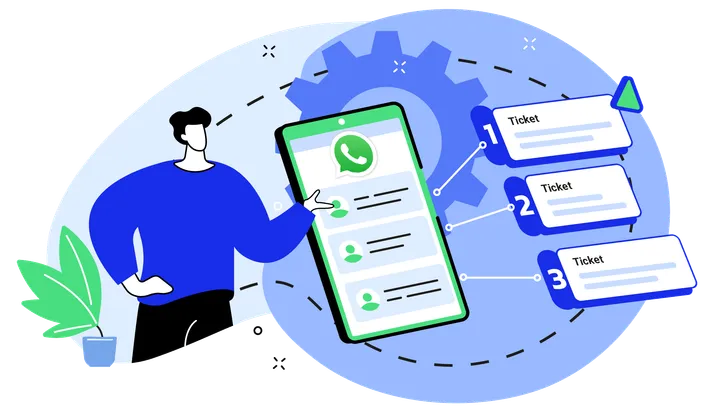
When the information is not available in the knowledge base and the AI chatbot is unable to respond, escalation to a human agent must be seamless. Context and attachments are carried over. The user receives status notifications, sees the agent’s first name, an estimated response time, and a handover message when the conversation resumes.
Operational impact: costs, volumes, SLAs
Deflection vs. phone and email
An automated intelligent assistant handles recurring tickets. Phone support is reserved for urgent or sensitive matters. Email remains the channel for documentation. The WhatsApp AI chatbot handles instant and repetitive requests. All interactions are measurable.
Response standardization and quality
With each escalation from the intelligent chatbot, human experts can analyze missing information in the knowledge base and add it accordingly. Over time, the chatbot becomes increasingly autonomous and delivers higher-quality service.
Peak and seasonality management
Some industries experience strong seasonality, such as agriculture or tourism, leading to sharp volume spikes. The bot absorbs most of the traffic and then routes the remaining requests to agent queues based on skills and availability.
Essential technical integrations
CRM, ticketing, and knowledge base
Connection to your CRM and ticketing system enables status tracking, tagging, and customer profile enrichment. The knowledge base feeds the chatbot’s responses.
Payments, logistics, and shipment tracking
The bot can provide delivery status updates, initiate returns, check warranty coverage, and point users to the relevant terms and conditions. Webhooks trigger updates.
Analytics and reporting
Dashboards track volumes, response times, FCR, CSAT, and escalations. Insights highlight the topics that warrant improvement through the creation of an internal task force.
Compliance, security, and GDPR
Consent, purpose limitation, and data retention
Inform users about the purposes of data processing, obtain their consent, and comply with data retention periods. Provide opt-out mechanisms.
WhatsApp is a secure platform
WhatsApp has a clear strategy for enterprise adoption and commits to providing the highest possible level of security.
By default since 2016, WhatsApp applies end-to-end encryption to all messages, calls, photos, videos, and attachments using the Signal Protocol. Only the sender and the recipient hold the encryption keys — not even WhatsApp.
Application-level protection layers include two-step verification via PIN, proactive alerts in case of account takeover attempts, native blocking and reporting, app lock, and advanced privacy controls. These settings help limit impersonation, intrusions, and social engineering attacks.
Enterprise use cases and the WhatsApp Business Platform
With the Cloud API, messages remain encrypted using the Signal Protocol between the user’s app and the WhatsApp platform. They are then decrypted on the Cloud API service side and transmitted to the company via HTTPS/TLS, where they may be temporarily stored to ensure deliverability.
Companies using the WhatsApp Business app or an on-prem integration receive messages directly. In this case, the exchange is considered end-to-end encrypted up to the company’s system.
Usage compliance: a 24-hour customer service window applies, and pre-approved templates are required for brand-initiated messages sent outside this window. Opt-in is mandatory for proactive messaging.
In short: WhatsApp provides encryption, anti-abuse mechanisms, and user controls. It is up to the company to complement these with internal governance: roles and access management, data retention, traceability, and GDPR compliance.
Traceability and audit
Each conversation generates auditable records that can be reviewed. Anonymized exports support continuous improvement. For technical foundations, refer to the official WhatsApp Business Platform documentation: whatsapp.com/business/platform
KPIs to track and manage ROI
FCR, CSAT, NPS, AHT
FCR (First Contact Resolution): share of requests resolved without follow-up. CSAT: immediate post-interaction satisfaction. NPS: delayed customer recommendation score. AHT (Average Handling Time): average handling duration.
Escalation rate and backlog
Measure what is escalated to level 2 support. Monitor the volume of pending conversations and their aging. Most AI chatbots can be configured to automatically close conversations after a defined period of time.
Priority customer support use cases
Self-service, FAQs, returns, and warranties
The bot answers questions about delivery timelines, returns, known issues, and warranty procedures. It collects proof of purchase, creates a ticket, and sends a summary to the customer.
Proactive notifications and follow-ups
Opt-in required. Order status updates, appointment reminders, part availability notifications, or CSAT survey completion messages can be sent.
Guided troubleshooting and diagnostics
Issue prequalification and guided resolution workflows. Requesting photos or videos when needed. Offering a call time slot if the issue cannot be resolved.
Support channel comparison
| Criterion | Phone | Webchat | ||
|---|---|---|---|---|
| Perceived latency | Low | Medium | Variable | Low |
| Asynchronous | Yes | Yes | No | Mostly no |
| Rich media | Yes | Yes | No | Yes |
| Conversation history | Continuous | Fragmented | N/A | Session-based |
| Marginal cost | Low | Low | High | Medium |
| Measurability | High | High | Medium | High |
| Scalability | High | High | Low | Medium |
FIXEE turnkey solution: a branded WhatsApp AI chatbot in 15 days
Want to deploy quickly, fully branded, with no technical debt ?
FIXEE delivers a ready-to-use WhatsApp AI chatbot for customer support and after-sales teams.
What you get
Custom brand and tone : visual identity, welcome messages, buttons, and languages.
Knowledge base : extremely easy to set up. Your WhatsApp AI chatbot responds only based on the information you provide.
Native escalation to a human agent.
Full traceability : every interaction is logged, documented, and tracked end to end.
Operational compliance : opt-in management, WhatsApp-approved templates, 24-hour service window compliance, and legal notices.
Integrations without heavy development : built-in chat ticketing and knowledge base.
Performance management : dashboards for FCR, CSAT, AHT, automation rate, and escalations.
Security by design : roles and permissions, controlled data retention, encryption in transit, and internal auditability.
Why now
You benefit from WhatsApp’s massive adoption, faster response times, and phone deflection — while maintaining end-to-end, auditable interaction records.
FIXEE enables you to launch your intelligent chatbot in just 15 days.
FAQ
Does an intelligent WhatsApp chatbot fully replace human agents?
No. It filters and resolves repetitive cases. Human agents handle complex and emotional situations. They also drive continuous improvement of WhatsApp AI chatbots.
What personal data does the bot process?
Identity, conversation, attachments, and sometimes order data. Limit collection to what is necessary and inform the user.
Do you need a knowledge base to get started?
Yes, even a minimal one. It keeps answers relevant and supports continuous improvement based on every conversation handled.
How can you measure satisfaction on WhatsApp?
A short CSAT survey at the end of the conversation measures satisfaction effectively and tracks how it evolves.
Can you handle media (photos, videos) for diagnostics?
Yes. The chatbot can collect images and analyze them before replying. It can also share images or troubleshooting videos to illustrate resolution steps.
Conclusion
About the author
FIXEE