AI in after-sales service: why 3 out of 4 teams don't see the ROI
AI spending in customer service up 38%, positive ROI for only 24% (Gartner). Where does value get lost between prototype, productivity and financial results?
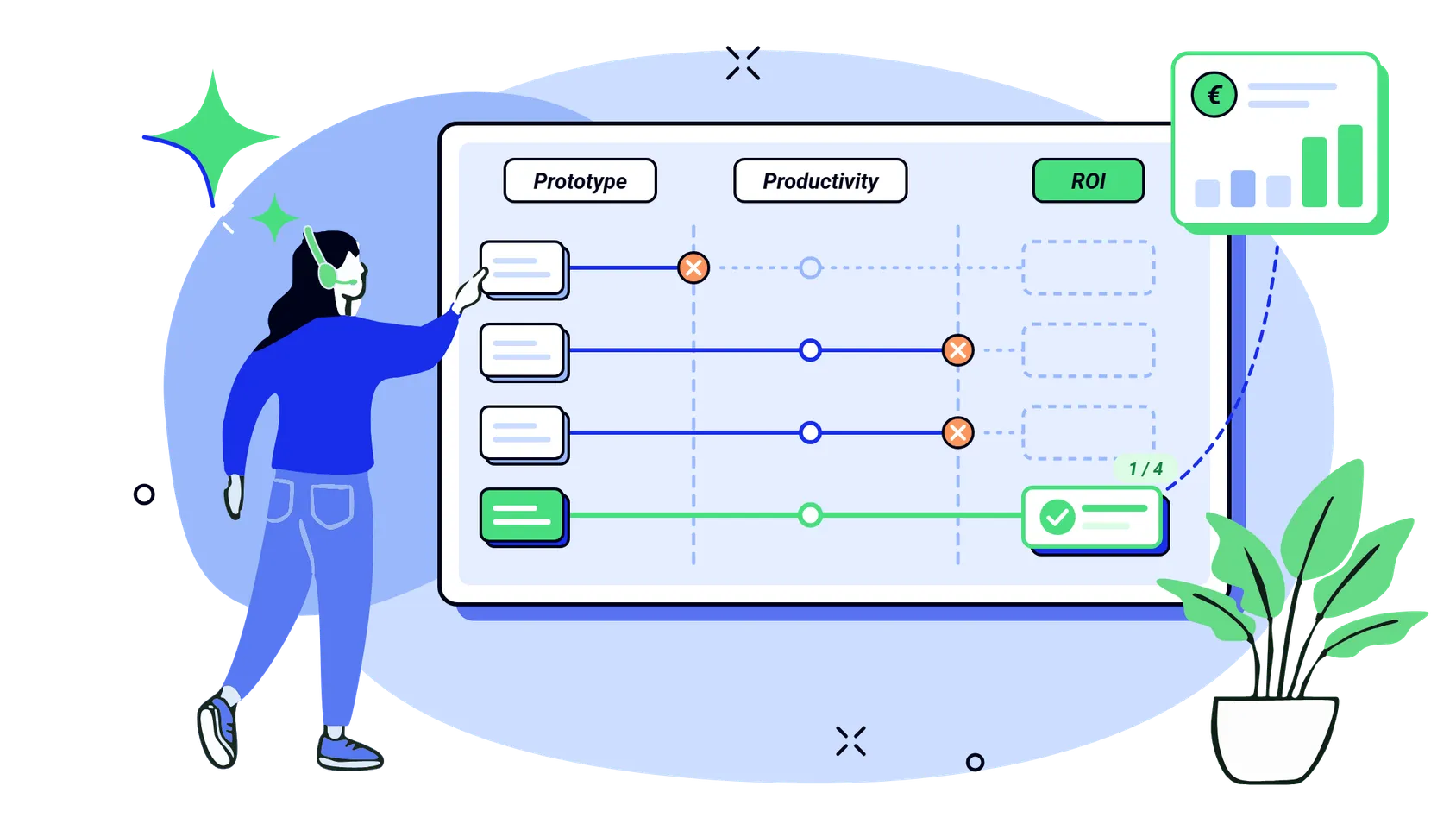
AI spending by customer service leaders rose by 38% in 2026, while their overall budget grew by just 2%, according to Gartner. Yet only 24% of the Service & Support leaders surveyed by Gartner report demonstrating a positive financial return on their AI use cases.
In industrial aftermarket and field services, McKinsey also sees plenty of promising projects, but still few companies able to turn those results into measurable P&L impact.
So where does the value get lost?
Start from the problem, not from AI
91% of Service & Support leaders say they are under pressure from their executives to implement AI, according to Gartner.
That pressure can easily turn the reasoning upside down: pick a chatbot, an assistant or an AI agent first, then look for something to use it on.
You should start with the problems of your after-sales service instead:
- What friction do customers run into when dealing with your service?
- Where do technicians lose time? Why?
- What share of requests are repetitive?
- Which site visits could be avoided?
- What is the average time to diagnosis? Why?
How easy it now is to prototype a software interface reinforces this bias: a convincing first demo can be built very quickly, before integration, data and measurement issues have been dealt with.
BCG notes that early adopters often get one-off productivity gains without reaching the expected ROI, mainly because their first use cases don’t go far enough, or because scaling up fails.
AI has to know your after-sales service, and be framed
A generic AI can explain an error code from a manual.
But to really help a technician or a customer, it should also know that this fault has already occurred on this machine range, which fixes worked, which parts were replaced and what has already been tried on this specific piece of equipment.
That information is rarely in one place.
It is scattered across technical documentation, CRM, ERP, tickets, intervention reports, machine histories, WhatsApp, emails and technicians’ know-how.
McKinsey singles out this data fragmentation and legacy systems as two of the main obstacles to scaling AI in aftermarket and field services.
Choosing the AI model is therefore only a small part of the project. Value depends above all on the business context the AI can access, and on the framework around it (the harness):
- How does it find the right information among thousands of documents?
- How does it know which question to ask at the right time in your business context?
- How does it adapt to your personas (a distributor’s needs differ from an end customer’s)?
- How do you make sure it answers based on your knowledge, not on its model’s general knowledge?
This framework decides whether the AI builds on your after-sales service, or misses the point.
A productivity gain is not ROI
Suppose an assistant saves a technician 20 minutes a day.
The gain is real. But if nothing changes downstream, the cost of your after-sales service stays practically the same.
To create value, those 20 minutes have to turn into something concrete:
- Better remote diagnosis: fewer site visits, and therefore a lower intervention cost.
- Less time spent searching: more requests handled, and therefore extra capacity without hiring.
- Automatically documented interventions: reusable knowledge, and therefore faster resolutions next time.
That is why adding Copilot, ChatGPT or Claude to an existing step is not always enough.
BCG recommends going beyond simple productivity gains to rethink processes and workflows around AI. Gartner makes the same point about the customer journey: rather than adding isolated chatbots, companies need to build journeys in which AI genuinely helps solve the problem end to end.
In after-sales service, writing a report five minutes faster is useful. Making sure the intervention automatically feeds the equipment history and can be used the next time it breaks down creates a far more interesting loop:
Every resolution speeds up the next one.
From AI that works to AI that pays off
The Gartner figures point less to a limit of AI in after-sales service than to confusion between three levels of maturity:
- AI that works: it can perform the task.
- AI that is useful: it has the right context and genuinely improves after-sales work.
- AI that is profitable: that operational gain turns into lower costs, extra capacity or revenue.
This is usually where ROI gets lost: somewhere between these three stages.
So before launching a new AI project, the first question is not “which AI tool should we implement?” but “which problem do we want to solve, and for which business goal?”