AI ticketing software: how to choose for an industrial technical hotline?
Microsoft Dynamics 365, Zendesk, Freshdesk or FIXEE. For an equipment manufacturer or distributor, the decision depends as much on the resources to commit as on the features. The goal: make the hotline more efficient quickly and capitalize on resolutions over time.
When around fifty resolutions become useful to customers abroad
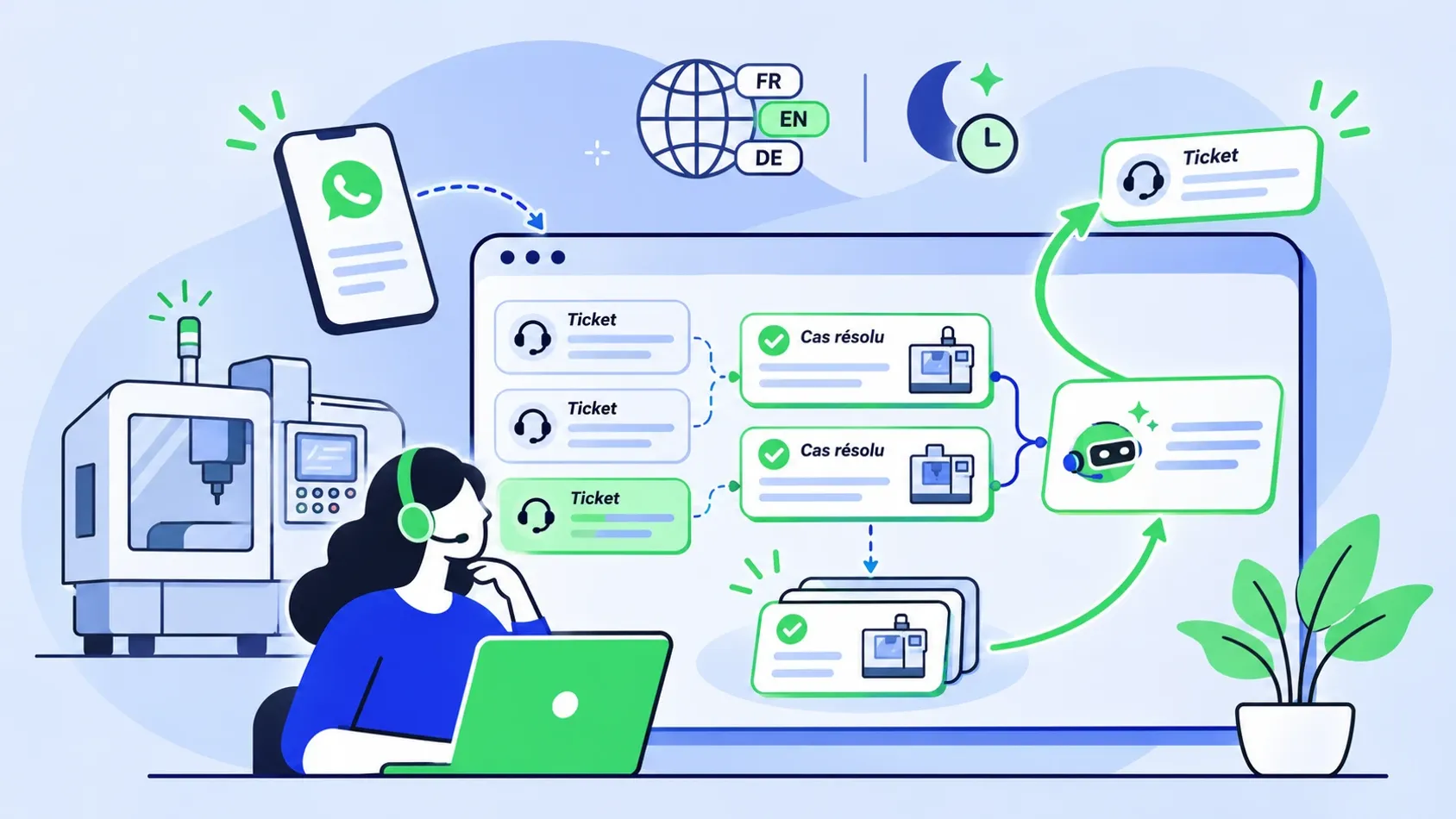
At an industrial packaging machinery manufacturer, customers do not all work French office hours. Their requests arrive, among other channels, on WhatsApp. To give a useful answer, you need to know the machine model concerned, find the case history and have a validated diagnosis, even after the service has closed for the day.
This company uses FIXEE for its support. Within a few weeks of use, it had built up around 50 validated Resolved Cases, linked to machine models in the Assets repository. Askia Client can draw on this knowledge to answer known questions, in several languages and outside opening hours. New problems are picked up by the team.
In many technical hotlines, the starting setup is simple: a shared mailbox, a few spreadsheets, direct messages to technicians. This closeness feels reassuring. Then volumes grow, people change, experts get called in the evening and at weekends. A diagnosis already made stays in an absent employee’s inbox. Someone else repeats the same checks. Energy is scattered and customers grow impatient. And it is only when something happens, a team member leaving or a clash with a customer, that the issue finally, and far too late, lands on management’s desk.
Why equip yourself? Four outcomes, over two horizons
In the short term: a better customer experience and more requests handled
1. Customer experience
A plant facing a stoppage or a malfunction wants to be taken care of quickly. It expects an identified contact, reliable information and continuity of follow-up. A shared case file gives it this reassuring visibility and saves it from calling back to find out where its case stands, calls in which it is asked for the same explanations every time.
2. Productivity
An experienced hotliner is a rare resource. They know the equipment, the recurring faults and the people who can unblock a situation. Their time should go to the cases where this expertise really makes a difference. AI ticketing prepares the request, qualifies it and gathers the available context. The hotliner can handle several cases in parallel, then start a phone conversation or a video assistance session when it adds something to the resolution. Experts step in at the right time, with the history in front of them. The goal is to handle more requests with the same headcount, without wearing out the team.
In the longer term: continuous improvement and servitization
1. Continuous improvement
Tickets record what quality, engineering and R&D need to understand: symptoms, conditions of occurrence, components involved, causes identified and solutions applied. A structured Resolved Case speeds up the next diagnosis. Several comparable situations also bring out ideas for improving the equipment or the support procedures.
2. Servitization
For an equipment manufacturer, developing recurring revenue through services means being able to keep its commitments over time. Support quality then becomes a competitive advantage. Customers need simple means of communication, requests must be tracked, the service delivered must be measured and demonstrated, and resolutions must be used to continuously improve support. AI ticketing provides this operational foundation. On-site intervention management and invoicing generally remain with the ERP or specialized tools.
These horizons come together
In the short term, AI ticketing makes it possible to handle more requests with the same headcount, reduce pressure on teams and improve customer satisfaction. In the longer term, each resolution enriches a body of knowledge that speeds up subsequent diagnoses and improves service quality. Like compound interest, immediate gains thus feed growing benefits for the company.
Comparison: Dynamics 365, Zendesk and Freshdesk
Microsoft Dynamics 365: a CRM project before being a hotline project
In an environment heavily equipped with Microsoft, Dynamics 365 Customer Service looks like a natural extension of the information system. The platform offers case management, knowledge sharing, automation and Copilot features. The challenge is to adapt the CRM’s processes to the habits of a hotline organized around machine models, technical incidents and occasional contributions from experts.
Business Central and Customer Service remain two separate applications. Licenses, data to synchronize and customizations must be defined separately. An SME may well already use the Microsoft ERP and still have to launch a new project to equip its hotline.
An industrial equipment maker that leads its market uses Microsoft Dynamics 365 as its foundation but chose FIXEE to strengthen its premium support offering worldwide, across three geographical regions. The choice was driven by complementarity, ease of implementation and flexibility of use.
Dynamics suits a company that is already carrying out an in-depth CRM transformation, with a significant change management effort and IT resources for integration and administration. For a team of two to four hotliners, this effort must be justified by a broader need than simply handling technical requests.
Zendesk: strong integration capabilities, at the cost of configuration work
Zendesk has a mature platform, AI capabilities and a wide choice of integrations with other systems. That is its strength for an already organized customer service. But linking cases to the equipment model, its history and the information useful for diagnosis requires building and maintaining a business configuration. Zendesk documents in particular this asset management using custom objects and their relationships.
A distributor of equipment and tooling was using Zendesk (around 6,000 tickets a year) and chose to switch to FIXEE for its after-sales service. It wanted quick access to the benefits of AI, without committing to a heavy configuration and setup project. This decision illustrates the real trade-off: having many possibilities, or quickly getting a return on investment at company level thanks to usage tailored to the business.
For Zendesk, ask for details of the business objects to configure, any integration services and the administration tasks that will remain with your team once the solution is deployed.
Freshdesk: easy to get started, more demanding for modeling the business
Freshdesk offers an accessible answer for a team that wants to move beyond the shared mailbox. Ticketing, automation, AI and collaboration features make up a solid foundation for a general-purpose customer service.
The work begins when you need to track the installed base: which customer does the equipment belong to, what is its configuration, which incidents have already been handled? Freshdesk Omni offers custom objects in its Enterprise plan. You then need to design their relationships with tickets and organize data updates.
On top of that, an industrial hotline uses tools specific to its business, such as interactive video assistance. It is used to see the situation on the machine and guide the customer. The Freshdesk Omni pricing grid does not mention interactive video assistance built into the business workflow. Third-party apps make it possible to add video uses via its marketplace. Depending on the tools chosen, additional costs may apply; you also need to examine how video connects to the ticket, the equipment and the case history.
Four solutions: what they bring and the effort to plan for
This table summarizes what each solution brings and what the hotline needs to put in place to get decisive benefits from it.
| Solution | What it brings | The work to plan for a technical hotline |
|---|---|---|
| Dynamics 365 Customer Service | Integration with the Microsoft ERP and CRM ecosystem | Define the applications, licenses and integrations needed. Adapt business processes to those offered natively by the solution. Plan administration resources. |
| Zendesk | Mature, scalable omnichannel platform | Configure processes for equipment support. Check the cumulative budget of the options needed for these processes. Assess the need for external support and long-term maintenance. |
| Freshdesk Omni | Accessible and general-purpose | Model the equipment, its links with tickets and the technical workflows. Check the features included in the plan. |
| FIXEE | Business-specific solution, asset context and reuse of resolutions | Deploy the entry points and regularly validate Resolved Cases. |
The path to results: three steps
1. Control the entry points
This is the first success factor. As long as a customer contacts their usual technician directly, a salesperson passes on a request outside the circuit, or a WhatsApp conversation stays on a personal phone, the service does not have a reliable business process. Customers need simple contact points that they know, and requests need to be centralized in shared tracking.
FIXEE brings together requests arriving by email, WhatsApp, Teams and web chat, among others. Customers keep their communication habits and the hotline finds the exchanges in its AI-augmented ticketing.
2. Save time from the very first cases
The team must see the benefit of ticketing from the very first cases. A request arrives qualified, linked to the equipment model and the available history. The hotliner finds the documents, calls on a colleague and handles several cases in parallel. They launch a video assistance session when the situation calls for a remote examination.
The perceived gains are:
- less time spent asking for information
- fewer redundant requests
- less stress and pressure thanks to the time recovered from the two previous gains
These gains make adoption easier and support continuity of follow-up when several departments are involved.
3. Turn resolutions into reusable knowledge
After resolution, the useful information feeds the Resolved Cases. Human validation keeps the knowledge reliable and determines what can be shared. Askia Hotliner draws on the accessible cases to assist the teams. Askia Client uses those that are validated and authorized to answer customers’ questions. The cases remain linked to the equipment concerned.
An integrator of plastics processing equipment built up around 200 Resolved Cases in 9 months. Its hotliners consult them with Askia Hotliner to find diagnostic elements and prepare technical answers. For this customer, usage remains internal. Other customers make part of this knowledge available to their own customers, under conditions, via Askia Client.
Each organization therefore uses this capitalization differently. The manufacturer shares validated knowledge with its international customer base. The integrator reserves its 200 Resolved Cases for the hotliners who prepare diagnoses and technical answers.
FIXEE covers this scope. Projects involving a global CRM, large-scale field technician scheduling and complex invoicing belong to other tools, to which support can be connected.
Budget for the resources needed, not just the licenses
Once the expected results and the adoption path are defined, three cost items make it possible to compare proposals on a realistic basis.
Licenses and options. How many people need access (permanent staff, occasional internal or external contributors)? Which rights, channels, AI volumes and equipment-related features are actually included in the chosen plan? The price per person alone does not describe what the team will be able to use. This can quickly complicate the choice of plan in a business that requires broad collaboration, and then its administration as people join and leave.
Implementation. Who organizes the contact points, prepares the documents, imports the history, configures the rules and trains users? Which services are included? The quote must cover a useful operation, not simply the opening of an account.
Administration and long-term adoption. Who manages access, monitors usage, adapts the rules and ensures the quality of the knowledge? In a two-person hotline, this work often falls to the after-sales manager or the technical expert. A larger organization can assign a dedicated person to it. To compare solutions, look at the time taken away from operational work.
For FIXEE, delivering customer support should not be constrained by the number of licenses. Value is created when information flows and is used to resolve faster. Subscriptions therefore include an unlimited number of internal and external users. What structures the plans is the functional scope, the usage volumes of certain high-value features, and the number of participants per ticket.
The first contact points can be opened within a few days. Implementation starts from 10 days for the START plan without options. Across all projects, the average implementation time is five weeks, particularly when a history import or an Askia Client customization is planned. Success depends above all on making the entry points official for customers and employees. The value of Resolved Cases then keeps growing at the pace of activity and of their validation.
How to choose without launching a disproportionate project?
Ask all four vendors for a demonstration on the same scenario: a WhatsApp request, identification of a machine model, an occasional intervention by an expert, a resolution, then finding that diagnosis again on a new request. Ask for details of the implementation time and the management workload that will remain with you.
A three-person hotline does not have the means to run a large IT project. The right choice is the one that delivers results now and makes it possible to get more with each new resolution. That is FIXEE’s mission: every resolution accelerates the next.
To assess the scope that fits your hotline:
FAQ: choosing AI ticketing software for technical support
Does a manufacturer with a single hotliner need AI ticketing software?
Yes, when they call on several experts, support different machines or handle international requests. Complexity comes from the number of pieces of equipment, cases and people involved, not just from the size of the support team.
What sets specialized AI ticketing for industrial technical support apart from general-purpose ticketing?
For industrial support, the tool must link each request to a piece of equipment, its documents and its history, and make collaboration with experts easier. The AI ticketing tool must also natively integrate specialized tools such as interactive video assistance, to see the situation on the machine and guide the customer remotely. FIXEE has designed the customer and employee journeys for an optimal support experience. Resolutions then feed the Resolved Cases, validated and then reused by Askia Hotliner and, depending on permissions, by Askia Client.
Can Resolved Cases remain reserved for internal teams?
Yes. Askia Hotliner relies on the knowledge authorized for hotliners. Askia Client uses the cases validated for sharing with customers.
How long does it take for AI to become useful?
Existing technical documents can be used from the very first uses. Resolved Cases then increase the number of known problems that teams and Askia can find. The key is to organize regular validation of the cases.
What is an alternative to Zendesk for an industrial technical hotline?
For an equipment manufacturer’s or distributor’s hotline, FIXEE is the best alternative to Zendesk to consider when the priority is to quickly have contextualized ticketing and AI features suited to technical support. For example, a distributor of complex equipment handling around 6,000 tickets a year chose to switch from Zendesk to FIXEE to avoid a heavy configuration project.
About the author
Cyril Burkovic